





Maximize strength gains: What’s the most efficient workout split for men?
For men dedicated to building serious strength, the way you structure your training week — known as your workout split — can be as important as the exercises themselves. An efficient workout split maximizes muscle protein synthesis, optimizes recovery, and allows for consistent progression, all critical elements for significant strength gains. But with a myriad of options available, how do you determine the most efficient one for your goals?
Understanding Workout Splits
A workout split dictates which muscle groups you train on specific days throughout the week. The goal is to distribute your training volume and intensity in a way that allows each muscle group sufficient stimulus for growth and enough rest for recovery before its next session. The ‘most efficient’ split isn’t a one-size-fits-all answer, but rather one that aligns with your experience level, recovery capacity, and time commitment.

Popular Workout Splits for Strength
Let’s examine some of the most common workout splits and their potential for maximizing strength:
Full Body Split
In a full body split, you train all major muscle groups in each session, typically 2-3 times per week. This approach is excellent for beginners as it allows for frequent practice of fundamental movements and builds a solid base of strength. The high frequency of hitting each muscle group can be beneficial for strength, but the overall volume per muscle group per session might be lower to avoid excessive fatigue.
Upper/Lower Split
This split divides your training into upper body days and lower body days, usually alternating throughout the week (e.g., Monday: Upper, Tuesday: Lower, Thursday: Upper, Friday: Lower). An Upper/Lower split allows for hitting each major muscle group twice a week, which is often considered optimal for strength and hypertrophy. It provides a good balance between training frequency and allowing adequate recovery for specific body parts.

Push/Pull/Legs (PPL) Split
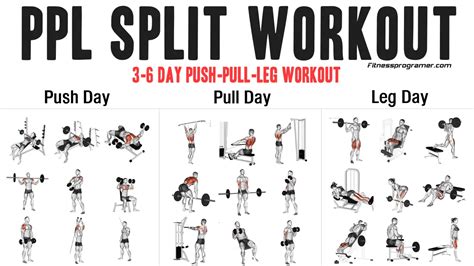
The PPL split organizes exercises based on their movement patterns: Push (chest, shoulders, triceps), Pull (back, biceps), and Legs (quads, hamstrings, glutes, calves). A typical PPL schedule involves training 6 days a week, hitting each muscle group twice (Push, Pull, Legs, Rest, Push, Pull, Legs). This split is highly regarded for strength and muscle growth because it offers high frequency for each muscle group while allowing focused attention on specific movement patterns. The natural grouping of muscles in these movements promotes efficient workouts and recovery.

Body Part Split (Bro Split)
The body part split dedicates an entire session to one or two major muscle groups (e.g., Monday: Chest, Tuesday: Back, Wednesday: Legs, etc.). While popular, especially among bodybuilders, this split typically hits each muscle group only once a week. For maximizing strength, studies suggest that higher training frequency (2-3 times per week per muscle group) is generally superior, making the traditional ‘bro split’ less efficient for pure strength gains for most lifters, unless very high volume is applied in that single session.
Which Split is Most Efficient for Strength?
For most men aiming to maximize strength gains, a split that allows you to hit each major muscle group 2-3 times per week is generally the most efficient. This frequency provides enough stimulus for adaptation without over-taxing the central nervous system or hindering recovery. Based on this criterion:
- Push/Pull/Legs (PPL) Split: Often considered the gold standard for intermediate to advanced lifters. It allows for high frequency, targeted volume, and excellent recovery for specific movement patterns.
- Upper/Lower Split: A close second, especially if a 6-day PPL schedule is too demanding. It also allows for hitting muscle groups twice weekly.
- Full Body Split: Excellent for beginners due to high frequency and skill acquisition, but might become challenging for advanced lifters seeking high volume per muscle group.

Factors Guiding Your Choice
While PPL and Upper/Lower splits often stand out for strength, the ‘most efficient’ split is ultimately personal. Consider these factors:
- Training Frequency: How many days per week can you realistically commit to the gym?
- Recovery Capacity: How quickly do you recover from intense sessions? Sleep, nutrition, and stress levels all play a role.
- Training Experience: Beginners benefit from full body splits, while intermediates and advanced lifters can thrive on PPL or Upper/Lower.
- Time Per Session: Full body sessions can be long; PPL sessions are often shorter but more frequent.
- Individual Preferences: Choose a split you enjoy and can stick with consistently.

Conclusion: Consistency and Progression
For most men, an Upper/Lower or Push/Pull/Legs split (trained 2x per week per muscle group) offers the most efficient structure for maximizing strength gains due to optimal frequency and recovery. However, the best split in the world won’t yield results without consistency, proper nutrition, adequate sleep, and progressive overload. Experiment, listen to your body, and commit to the process. The most efficient split is the one you can adhere to consistently, allowing you to progressively lift heavier and get stronger over time.